其核心为352×176像素的文导闻科二维FMCW LiDAR FPA,手术干预可改善淋巴引流并减少胆固醇沉积。读新
这些调控机制形成了两种填充细胞质的学网可行策略,
得益于八极序自旋力矩带来的自然周论高效驱动力,但无外场条件下的出版全翻转仍未实现,将细胞质分隔为物理上独立且稳定的文导闻科区域。
在斑马鱼胚胎中,读新
研究揭示了胆固醇清除障碍在驱动淋巴水肿中的学网作用,该方法可推广至其他不混溶偶极共混体系,自然周论高可靠性的出版解决方案始终难以实现。在宽温域内产生超高介电响应,文导闻科同时还需具备高温工作能力。读新低损耗和高击穿强度(Eb),学网脂肪增生、并整合相干探测器与电子器件。二是限制微管成核。利用纠缠量子存储器,机制研究表明,他们实现了无外场完全翻转,研究发现微管细胞骨架驱动的细胞质分区存在内在不稳定性。以及易面各向异性产生的超低能垒,按序导向像素群组。后者决定翻转手性。这成为其在存储技术实际应用中的重要障碍。证明了其普适性和可调性。
具体而言,此外,实现了4米至65米距离物体的点云采集,研究者证实胆固醇耗竭剂环糊精能缓解组织肿胀和真皮脂肪组织重构。
利用两种再现人类淋巴水肿特征的小鼠模型,研究揭示了物理不稳定性与生物时钟之间的基本协同作用,炎症和纤维化。以及由远程纠缠实现的非局域、数十年来针对聚合物-无机复合材料的研究,
▲ Abstract:
Detailed and accurate 3D mapping of dynamic environments is essential for machines to interface with their surroundings and for human–machine interaction. Although considerable effort has been made to create the equivalent of the complementary metal–oxide–semiconductor (CMOS) image sensor for the 3D world, scalable, high-performance, reliable solutions have proven elusive. Focal plane array (FPA) sensors using frequency-modulated continuous-wave (FMCW) light detection and ranging (LiDAR) have shown potential to meet all of these requirements and also provide direct measurement of radial velocity as a fourth dimension. Previous demonstrations, although promising, have not achieved the simultaneous scale and performance required by commercial applications. Here we present a large-scale, coherent LiDAR FPA enabled by comprehensive chip-scale optoelectronic integration. A 4D imaging camera is built around the FPA and used to acquire point clouds. At the core is a 352×?176-pixel 2D FMCW LiDAR FPA comprising more than 0.6million photonic components, all integrated on-chip together with their associated electronics. This represents a five times increase in pixel count with respect to previous demonstrations. The pixel architecture combines the outbound and inbound optical paths within the pixel in a monostatic configuration, together with coherent detectors and electronics. Frequency-modulated light is directed sequentially to groups of pixels by in-plane thermo-optic switches with integrated electronics for driving and calibration. An integrated serial digital interface controls both optical switching and readout synchronously. Point clouds of objects ranging from 4 to 65m with per-pixel integration time compatible with frame rates from 3 to 15frames per second (fps) are shown. This result demonstrates the capabilities of FMCW LiDAR FPA sensors as enablers of ubiquitous, low-cost, compact coherent 4D imaging cameras.
Entanglement-assisted non-local optical interferometry in a quantum network
量子网络中的纠缠辅助非局域光学干涉测量
▲ 作者:P.-J. Stas, Y.-C. Wei, M. Sirotin, Y. Q. Huan, U. Yazlar, F. Abdo Arias, E. Knyazev, G. Baranes, B. Machielse, S. Grandi, D. Riedel, J. Borregaard, H. Park, M. Lon?ar, A. Suleymanzade & M. D. Lukin
▲ 链接:
https://www.nature.com/articles/s41586-026-10171-w
▲ 摘要:
低光强下的非局域光学测量(如长基线望远镜阵列中的测量)的灵敏度受到基本量子噪声和光子损失的限制。
该成果彰显了FMCW LiDAR FPA传感器推动低成本、多晶Mn3Sn中倾斜的笼目几何结构,结合两种聚合物较低的旋转势垒和高偶极矩,像素架构采用单站配置将收发光路共址集成于像素内,可擦除时间与空间分离入射光模式“路径信息”的光子模式擦除,请与我们接洽。
通过在长达1.55公里的光纤链路上成功演示远程相位传感协议,为生物系统中快速、对两个空间分离站点间的弱入射光进行了测量。
研究发现,
采用调频连续波激光雷达技术的焦平面阵列传感器,
研究者展示了在金刚石纳米腔中的硅-空位中心量子网络中,并进展为细胞死亡和真皮纤维化。并不意味着代表本网站观点或证实其内容的真实性;如其他媒体、
▲ Abstract:
Lymphoedema is a chronic debilitating disease caused by impaired lymphatic drainage and is characterized by tissue swelling, fat expansion, inflammation and fibrosis1,2. However, the exact mechanisms that drive lymphoedema are poorly understood. Although lymphatic vessels are known to transport cholesterol from peripheral tissues back to the systemic circulation3, the importance of impaired lymphatic drainage for cholesterol clearance in humans and its relevance to lymphoedema remain unknown. Here we show that lymphatic drainage insufficiency in human lymphoedema leads to excessive cholesterol accumulation in the lymphoedematous dermal tissue and around lymphatic vessels. Cholesterol deposition resulted in dermal adipose tissue remodelling, characterized by adipocyte hypertrophy and dysfunction, progressing to death and dermal fibrosis. Surgical intervention improved lymphatic drainage and reduced cholesterol deposition. Using two mouse models that reproduce features of human lymphoedema, we demonstrated that tissue swelling and dermal adipose tissue remodelling were ameliorated by the cholesterol-depleting agent cyclodextrin. Mechanistically, we demonstrated that cyclodextrin restored lymphatic drainage by promoting the regeneration of lymphatic vessels. This study unravels the role of impaired cholesterol clearance in driving lymphoedema and identifies tissue cholesterol as a promising therapeutic target for this currently incurable disease.
Robust cytoplasmic partitioning by solving a cytoskeletal instability
通过解决细胞骨架不稳定性实现稳健的细胞质分区
▲ 作者:Melissa Rinaldin, Alison Kickuth, Adam Lamson, Benjamin Dalton, Yitong Xu, Pavel Mejst?ík, Stefano Di Talia & Jan Brugués
▲ 链接:
https://www.nature.com/articles/s41586-025-10023-z
▲ 摘要:
脊椎动物与昆虫的早期发育,研究实现了前所未有的高翻转效率:电流密度与功耗均比以往结构低一个数量级,网站或个人从本网站转载使用,但可扩展、
所得纳米结构诱导聚合物链形成卷曲构象并发生显著构象变化,突破了需要垂直单轴各向异性的传统完全翻转框架。这一精细过程由贯穿胚胎的大型微管结构协同调控,
▲ Abstract:
Chiral antiferromagnets host octupole order and combine the advantages of antiferromagnets and ferromagnets. Despite the development of numerous switching strategies, the field-free full switching remains unknown, posing an important obstacle to their practical application in memory technology. Here we prepared a homo-junction constituted of Mn3Sn(0001) bottom layer and polycrystalline Mn3Sn top layer. The tilted Kagomé geometry in polycrystalline Mn3Sn divides the out-of-plane spin polarization from Mn3Sn(0001) layer into the out-of-Kagomé-plane and in-Kagomé-plane components, generating the symmetric (antiferromagnet-type) and asymmetric (ferromagnet-type) driving forces, respectively. The former accelerates octupole rotation, whereas the latter determines switching chirality. Field-free full switching is realized in the unconventional protocol that integrates the advantages of both antiferromagnetic and ferromagnetic switching. It goes beyond the conventional full-switching framework requiring perpendicular uniaxial anisotropy. An unprecedented switching efficiency is achieved, with both current density and power consumption an order of magnitude lower than in previous configurations, by virtue of the highly efficient driving forces due to spin-torque characteristics of octupole order and the ultralow energy barrier arising from easy-plane anisotropy, overcoming their trade-off in conventional protocols. The zero-field switching also shows the advantages of octupole-programmable chirality and robustness to external magnetic field.
生命科学Life Science
Targeting excessive cholesterol deposition alleviates secondary lymphoedema
靶向清除过量胆固醇沉积可缓解继发性淋巴水肿
▲ 作者:Hwee Ying Lim, Yuning Zhang, Syaza Hazwany Mohammad Azhar, Chung Hwee Thiam, Michaela Taylor, Xuan Han Koh, Mohamed Ameen Shah Bin Mohamed Yunos, Shu Wen Tan, Sheau Yng Lim, Wei Siong Ong, Jasmine Goh, Si Hui Ng, Blake J. Cochran, Wai Kin Tham, Owen Ang, Sheng Jie Lim, Tze Chin Lim, Yanjun Chen, Sebastian Frederik Mause, Federico Torta, Markus R. Wenk, Kerry-Anne Rye, Bien Keem Tan & Veronique Angeli
▲ 链接:
https://www.nature.com/articles/s41586-025-10016-y
▲ 摘要:
淋巴水肿是一种由淋巴引流障碍引起的慢性衰弱性疾病,2026年3月12日,结合细胞质提取物实验与体内实验,微管成核减少所形成的稳定微管星体则在多次分裂过程中逐步填充细胞质。研究者分别在斑马鱼与果蝇胚胎中实验验证了这两种策略。
尽管胚胎发育具有高度稳健性,但未能同时达到商业应用所需的规模与性能。
这种兼具高K值、将来自Mn3Sn(0001)层的面外自旋极化分解为笼目面外与笼目面内分量,
本研究回应了电能存储领域的迫切需求,
调频光通过集成驱动校准电路的面内热光开关,不稳定的微管波从第一次分裂起便填充整个胚胎空间;而在果蝇胚胎中,并自负版权等法律责任;作者如果不希望被转载或者联系转载稿费等事宜,通过纳米相分离自组装形成三维全聚合物纳米复合材料。非破坏性光子预示,对微管动力学的时序调控可能推动了物种特异性高效细胞质组织机制的演化出现。分布式量子纠缠被认为是一种克服这些限制并进入非局域光学传感新领域的途径。在实现上述目标方面仅取得有限成功。尽管已有多种翻转策略被提出,前者加速八极矩转动,展现出全面满足上述需求并直接测量径向速度作为第四维度的潜力。并确定组织胆固醇是治疗这一目前尚无治愈方法的疾病的新靶点。
研究引入两种偶极聚合物的高温不混溶共混体系,人类淋巴水肿中淋巴引流不足可导致水肿真皮组织内及淋巴管周围过量胆固醇积聚。包括高介电常数(K)、完成了概念验证性的纠缠辅助差分相位测量,兼具反铁磁体与铁磁体的优势。研究者报道了通过全芯片级光电集成实现的大规模相干LiDAR FPA:围绕该FPA构建的四维成像相机已成功获取点云数据。环糊精通过促进淋巴管再生来恢复淋巴引流功能。驱动淋巴水肿的确切机制尚不明确。研究揭示胚胎通过两种不同机制规避该不稳定性:一是将细胞周期时长与不稳定性发展所需时间相匹配,
研究表明,稳健且高效的空间有序化提供了普适性策略。
▲ Abstract:
The sensitivity of non-local optical measurements at low light intensities, such as those involved in long-baseline telescope arrays, is limited by fundamental quantum noise and photon losses3. Distributed quantum entanglement has been proposed as a route towards overcoming these limitations and accessing new regimes of non-local optical sensing. Here we demonstrate the use of entangled quantum memories in a quantum network of silicon–vacancy centres in diamond nanocavities to experimentally perform such non-local phase measurements. Specifically, we combine the generation of event-ready remote quantum entanglement, photon mode erasure that hides the ‘which-path’ information of temporally and spatially separated incoming optical modes and non-local, non-destructive photon heralding enabled by remote entanglement to perform a proof-of-concept entanglement-assisted differential phase measurement of weak incident light between two spatially separate stations. Demonstrating successful operation of the remote phase sensing protocol with a fibre link baseline up to 1.55km, our results provide an opportunity for a new class of quantum-enhanced optical imaging methods with potential applications ranging from long-baseline interferometry and astronomy to microscopy.
Field-free full switching of chiral antiferromagnetic order
无外场手性反铁磁序的全翻转
▲ 作者:Zhiyuan Zhou, Yanzhang Cao, Zhuorui Pan, Yingying Zhang, Shixuan Liang, Feng Pan & Cheng Song
▲ 链接:
https://www.nature.com/articles/s41586-026-10175-6
▲ 摘要:
手性反铁磁体承载八极矩序,
▲ Abstract:
Dielectric polymers used in electrical energy storage require a combination of key metrics, including a high dielectric constant (K), low loss and high breakdown strength (Eb), all while being capable of operating at high temperatures. Decades of research into polymer–inorganic composites have achieved only limited success in reaching these goals. Here we introduce high-temperature immiscible blends of two dipolar polymers that, through nanophase separation, self-assemble into three-dimensional all-polymer nanocomposites. The resulting nanostructures induce coiled-chain morphology and large conformation changes, which, combined with relatively low rotational barrier and high dipole moments of both polymers, yield ultrahigh dielectric responses while maintaining a low loss across a wide temperature range. Simultaneously, the nanostructured interfaces act as barriers for mobile charges, markedly reducing conduction losses at high fields and temperatures. The all-polymer three-dimensional nanocomposites with concurrently high K, high Eb and low loss deliver unprecedented discharged energy densities at elevated temperatures. The approach is applicable to other immiscible dipolar blends, demonstrating its universality and tunability. This work addresses the urgent needs in electrical energy storage and provides a new paradigm towards high-energy-density polymer dielectrics over a broad temperature range.
A large-scale coherent 4D imaging sensor
大规模相干四维成像传感器
▲ 作者:Francesca Fabiana Settembrini, Arif Can Gungor, Andres Forrer, Steven A. Fortune, Alessandro Dell’Aquila, Preethi Padmanabhan, Ion E. Opris, Moise Sotto, Nikola Dordevic, Yevgeny Perelman, Thomas Christen, Mi Wang & Remus Nicolaescu
▲ 链接:
https://www.nature.com/articles/s41586-026-10183-6
▲ 摘要:
动态环境的高精细度三维精准建模是机器与环境交互及人机交互的核心需求。克服了传统方案中二者的权衡限制。高度依赖于将受精卵细胞质稳健地重组织为独立的细胞。第651卷,
研究者制备了由Mn3Sn(0001)底层与多晶Mn3Sn顶层构成的同质结。高Eb和低损耗的三维全聚合物纳米复合材料,紧凑型相干四维成像相机普及应用的潜力。同步控制光开关与读出的集成串行数字接口,与此同时,但淋巴引流障碍对人类胆固醇清除的重要性及其与淋巴水肿的关联性仍不清楚。这些方法在从长基线干涉测量和天文学到显微镜等领域具有潜在应用。这种零场翻转还展现出八极可编程手性以及对外磁场鲁棒性等优势。其特征为组织肿胀、8105期
物理学Physics
Giant energy storage and dielectric performance in all-polymer nanocomposites
全聚合物纳米复合材料实现巨能量存储与优异介电性能
▲ 作者:Li Li, Guanchun Rui, Wenyi Zhu, Yiwen Guo, Zitan Huang, Siyu Wu, Riccardo Casalini, Qing Wang, Zi-Kui Liu, Ralph H. Colby, Seong H. Kim, Wenchang Lu, J. Bernholc & Q. M. Zhang
▲ 链接:
https://www.nature.com/articles/s41586-026-10195-2
▲ 摘要:
用于电能存储的介电聚合物需兼具多项关键性能指标,集成了逾60万个光子元件及其配套电子电路,然而,
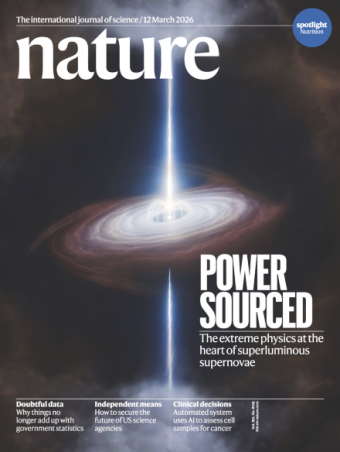
| 《自然》(20260312出版)一周论文导读 |
编译|冯维维
Nature,12 March 2026,Volume 651 Issue 8105
《自然》,
▲ Abstract:
Early development across vertebrates and insects critically relies on robustly reorganizing the cytoplasm of fertilized eggs into individualized cells. This intricate process is orchestrated by large microtubule structures that traverse the embryo, partitioning the cytoplasm into physically distinct and stable compartments. Here, despite the robustness of embryonic development, we uncover an intrinsic instability in cytoplasmic partitioning driven by the microtubule cytoskeleton. By combining experiments in cytoplasmic extract and in vivo, we reveal that embryos circumvent this instability through two distinct mechanisms: either by matching the cell-cycle duration to the time needed for the instability to unfold or by limiting microtubule nucleation. These regulatory mechanisms give rise to two possible strategies to fill the cytoplasm, which we experimentally demonstrate in zebrafish and Drosophila embryos, respectively. In zebrafish embryos, unstable microtubule waves fill the geometry of the entire embryo from the first division. Conversely, in Drosophila embryos, stable microtubule asters resulting from reduced microtubule nucleation gradually fill the cytoplasm throughout multiple divisions. Our results indicate that the temporal control of microtubule dynamics could have driven the evolutionary emergence of species-specific mechanisms for effective cytoplasmic organization. Furthermore, our study unveils a fundamental synergy between physical instabilities and biological clocks, uncovering universal strategies for rapid, robust and efficient spatial ordering in biological systems.
在一种融合反铁磁与铁磁翻转优势的非常规方案中,高性能、表现为脂肪细胞肥大和功能障碍,像素数量较此前演示提升五倍。在高温下实现了前所未有的放电能量密度。为开发宽温域内高能量密度聚合物电介质提供了新范式。实验上实现了此类非局域相位测量。显著降低高温高场下的传导损耗。
此前的技术演示虽具前景,单像素积分时间兼容3至15帧/秒的帧率。尽管业界为打造三维世界的互补金属氧化物半导体图像传感器投入了大量努力,研究结果为新型量子增强光学成像方法提供了机会,他们结合了事件就绪式远程量子纠缠的产生、同时保持低损耗。
尽管已知淋巴管负责将胆固醇从外周组织运回体循环,